

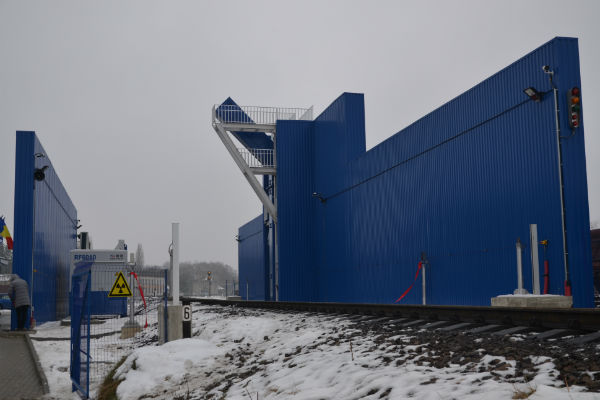
Modern scanner inaugurated at Ocnița railway customs post

The Ocnița railway customs post has now one of the most modern scanners existing at present. The Nuctech TMRF 6010 system is used to inspect railroad vehicles as they pass through the scanning tunnel, enabling to detect all types of undeclared goods.

The scanner was donated by the Government of the People’s Republic of China in the framework of a technical assistance project to the value of US$ 5.7 million. As part of the same project, the Chisinau International Airport customs post in May was outfitted with a Nuctech TMXT 2080AD scanner for inspecting checked-in baggage, IPN reports.

In the inauguration event on December 8, Customs Service detector Vitalie Vrabie said the enlargement of the commercial flows inherently leads to bigger fraud risks. That’s why it is important for the Customs Service to diversify the control instruments and to prevent possible damage or threats to regional security.

Attending the event, China’s Ambassador to Moldova Zhang Yinghong said the delivery of the customs inspection equipment is the result of the cooperation between Moldova and China within a project of major importance. The implementation of the project will enable to accelerate transfrontier transit, to fight smuggling and to fully collect the planned budget revenues.

The project was implemented under an intergovernmental agreement between the Republic of Moldova and the People’s Republic of China. The first stationary scanner was donate by the Government of the People’s Republic of China in 2015. This was installed at the Leușeni customs post.


Official documents issued in the Republic of Moldova and Germany may now be used in each other’s countries with only an apostille, without the need for the legalization procedure. The measure enters into force following the Federal Republic of Germany’s withdrawal of the reservation it made in 2007 when the Republic of Moldova acceded to the Hague Apostille Convention, IPN reports.

The Ministry of Foreign Affairs states that the decision was made following steps taken by Deputy Prime Minister Mihai Popsoi, Minister of Foreign Affairs, during his May 18–19 meeting with his German counterpart, Johann David Wadephul.

The ministry emphasizes that the new system will eliminate the need to visit multiple institutions or diplomatic missions to have documents legalized, which will reduce both the time required and the costs incurred by citizens. The simplified procedure will apply to official documents such as birth, marriage, divorce, and death certificates, criminal records, academic diplomas, and diploma supplements.

The Hague Convention on the Apostille entered into force for the Republic of Moldova on March 16, 2007. With its implementation in relations with Germany, the Republic of Moldova will benefit from the same simplified procedure for the recognition of official documents as it does with all 130 states and entities that are parties to the convention.

0 FacebookTwitterPinterestEmail


Modern scanner inaugurated at Ocnița railway customs post

The Ocnița railway customs post has now one of the most modern scanners existing at present. The Nuctech TMRF 6010 system is used to inspect railroad vehicles as they pass through the scanning tunnel, enabling to detect all types of undeclared goods.

The scanner was donated by the Government of the People’s Republic of China in the framework of a technical assistance project to the value of US$ 5.7 million. As part of the same project, the Chisinau International Airport customs post in May was outfitted with a Nuctech TMXT 2080AD scanner for inspecting checked-in baggage, IPN reports.

In the inauguration event on December 8, Customs Service detector Vitalie Vrabie said the enlargement of the commercial flows inherently leads to bigger fraud risks. That’s why it is important for the Customs Service to diversify the control instruments and to prevent possible damage or threats to regional security.

Attending the event, China’s Ambassador to Moldova Zhang Yinghong said the delivery of the customs inspection equipment is the result of the cooperation between Moldova and China within a project of major importance. The implementation of the project will enable to accelerate transfrontier transit, to fight smuggling and to fully collect the planned budget revenues.

The project was implemented under an intergovernmental agreement between the Republic of Moldova and the People’s Republic of China. The first stationary scanner was donate by the Government of the People’s Republic of China in 2015. This was installed at the Leușeni customs post.


Maritime schools could be opened in Moldova following the full transposition of relevant European legislation. The statement was made by Deputy Prime Minister Vladimir Bolea, Minister of Infrastructure and Regional Development, who noted that there is growing interest in such programs, including from Ukrainian citizens affected by the war, according to IPN.

Vladimir Bolea stated that the new regulations will allow seaman’s books to be issued based on studies completed in the Republic of Moldova at authorized institutions.

The minister told the press that, at present, no ships are sailing under the flag of the Republic of Moldova, but the authorities are working to transpose European legislation and develop the legal framework necessary for the development of this sector.

According to him, the state and the Naval Agency could generate significant revenue both from ships sailing under the Moldovan flag and from institutions that train seafarers.

0 FacebookTwitterPinterestEmail


1 IANUARIE, 2025
1 IANUARIE, 2025