

Life as a play

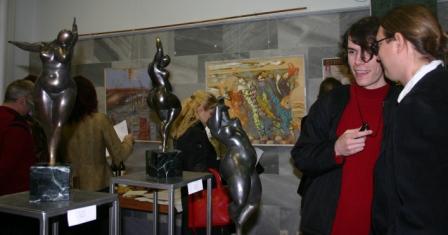
In April, the OSCE Mission to Moldova is hosting a double exhibition. The painters and spouses Ruslan and Ala Streleţ, together with the sculptors Veaceslav Zaitsev and Veaceslav Jiglitski invite beauty admirers to meditate on life through works displaying moments from the daily life seen as a drama play, Info-Prim Neo reports.

“Jazz”, “The Kiss”, “Aquarium”, “Playing Room”, “The Harlequins” are several titles from the collection of paintings presented by Ala and Ruslan Streleţ. The young artists want to present the life as an escape from concerns and problems. “We, the artists, see the reality this way. Certainly the reality is harsher, there ever are problems, but we see them through the prism of games, smiles, emotions. The atmosphere of the paintings is related even to the fantastic”, explained the painter Ruslan Streleţ at the opening ceremony of the exhibition. According to him, all the people, most often than not, wear masks they take off only when out of the daily routine.

The same attitude was adopted by Ala Streleţ in her works. According to her, through the non-figurative style she practices, her main streamline is to render emotions, feelings, experiences.

Those 25 works belong to post-traditionalism and expressionism. Ruslan Streleţ says his works are part of post-traditionalism, and Ala Streleţ’s ones can pertain more to the expressionism and non-figurative schools.

The direction of the Brancusi exhibition center and art critic, Tudor Braga, says the plastic discourse of the Streleţ spouses is a common one. In most of their works, they explore the fantastic on different planes. They use mediaeval motives, common for the European culture, especially the folklore, as well as the tools used by the modern art’s language.

Ala and Ruslan Streleţ expose their works in Romania, Ukraine, Polonia, UK, USA and other countries every year. Their works are now in private collections of people from Moldova, Ulraine, USA, Holland, France and Finland.


Official documents issued in the Republic of Moldova and Germany may now be used in each other’s countries with only an apostille, without the need for the legalization procedure. The measure enters into force following the Federal Republic of Germany’s withdrawal of the reservation it made in 2007 when the Republic of Moldova acceded to the Hague Apostille Convention, IPN reports.

The Ministry of Foreign Affairs states that the decision was made following steps taken by Deputy Prime Minister Mihai Popsoi, Minister of Foreign Affairs, during his May 18–19 meeting with his German counterpart, Johann David Wadephul.

The ministry emphasizes that the new system will eliminate the need to visit multiple institutions or diplomatic missions to have documents legalized, which will reduce both the time required and the costs incurred by citizens. The simplified procedure will apply to official documents such as birth, marriage, divorce, and death certificates, criminal records, academic diplomas, and diploma supplements.

The Hague Convention on the Apostille entered into force for the Republic of Moldova on March 16, 2007. With its implementation in relations with Germany, the Republic of Moldova will benefit from the same simplified procedure for the recognition of official documents as it does with all 130 states and entities that are parties to the convention.

0 FacebookTwitterPinterestEmail


Life as a play

In April, the OSCE Mission to Moldova is hosting a double exhibition. The painters and spouses Ruslan and Ala Streleţ, together with the sculptors Veaceslav Zaitsev and Veaceslav Jiglitski invite beauty admirers to meditate on life through works displaying moments from the daily life seen as a drama play, Info-Prim Neo reports.

“Jazz”, “The Kiss”, “Aquarium”, “Playing Room”, “The Harlequins” are several titles from the collection of paintings presented by Ala and Ruslan Streleţ. The young artists want to present the life as an escape from concerns and problems. “We, the artists, see the reality this way. Certainly the reality is harsher, there ever are problems, but we see them through the prism of games, smiles, emotions. The atmosphere of the paintings is related even to the fantastic”, explained the painter Ruslan Streleţ at the opening ceremony of the exhibition. According to him, all the people, most often than not, wear masks they take off only when out of the daily routine.

The same attitude was adopted by Ala Streleţ in her works. According to her, through the non-figurative style she practices, her main streamline is to render emotions, feelings, experiences.

Those 25 works belong to post-traditionalism and expressionism. Ruslan Streleţ says his works are part of post-traditionalism, and Ala Streleţ’s ones can pertain more to the expressionism and non-figurative schools.

The direction of the Brancusi exhibition center and art critic, Tudor Braga, says the plastic discourse of the Streleţ spouses is a common one. In most of their works, they explore the fantastic on different planes. They use mediaeval motives, common for the European culture, especially the folklore, as well as the tools used by the modern art’s language.

Ala and Ruslan Streleţ expose their works in Romania, Ukraine, Polonia, UK, USA and other countries every year. Their works are now in private collections of people from Moldova, Ulraine, USA, Holland, France and Finland.


Maritime schools could be opened in Moldova following the full transposition of relevant European legislation. The statement was made by Deputy Prime Minister Vladimir Bolea, Minister of Infrastructure and Regional Development, who noted that there is growing interest in such programs, including from Ukrainian citizens affected by the war, according to IPN.

Vladimir Bolea stated that the new regulations will allow seaman’s books to be issued based on studies completed in the Republic of Moldova at authorized institutions.

The minister told the press that, at present, no ships are sailing under the flag of the Republic of Moldova, but the authorities are working to transpose European legislation and develop the legal framework necessary for the development of this sector.

According to him, the state and the Naval Agency could generate significant revenue both from ships sailing under the Moldovan flag and from institutions that train seafarers.

0 FacebookTwitterPinterestEmail


1 IANUARIE, 2025
1 IANUARIE, 2025