

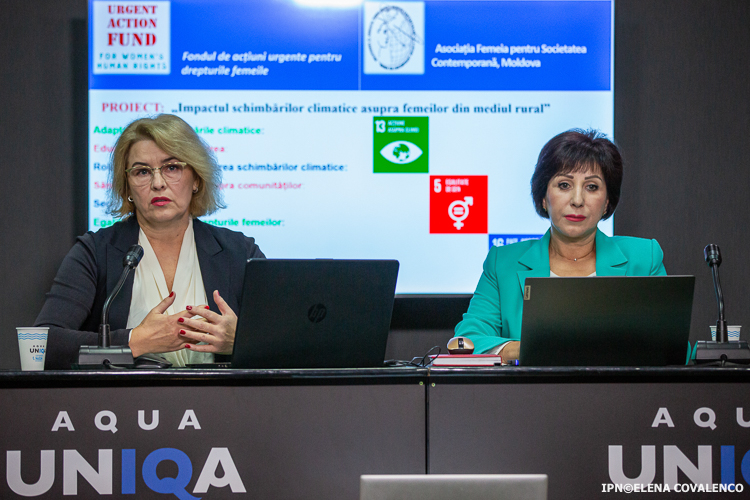
Impact of climate change is more visible on women and children from rural areas, association

Climate change brought negative consequences for rural areas, generating a significant decline in crops. The decreases lead to food insecurity in rural communities. The extreme drought the past few years and the nonuse of drip irrigation affected the harvest and threaten food security. The impact of climate change is more visible on women and children from rural areas. The major dangers generated by climate change were addressed in the framework of the project “Impact of climate change is more visible on women from rural areas” which was implemented by the Association “Women for a Contemporary Society”.

In a news conference hosted by IPN, Veronica Lupu, head of the Association “Women for a Contemporary Society” and project director, said the project was designed to discuss climate change, the effects of climate change in the Republic of Moldova, the impact and the persons who are vulnerable in this regard. “Emphasis was placed on an important number of persons – 25 women from rural areas. We aimed to reach women who are interested, skilled, are representatives of NGOs and of state institutions,” stated Veronica Lupu.

Maria Kuleshov, expert of the project, said that climate change is one of the most serious threats faced by society in the 21st century and its impact is felt not only in Moldova, but all over the world, primarily in rural areas. The rise in temperatures affects agricultural production in rural areas. The declines in crops lead to food insecurity in many rural communities.

The World Bank estimates that the losses caused by climate change in agriculture amount to US$ 1 billion a year globally. This directly affects the incomes of the rural population and their capacity to support themselves financially.

Biodiversity loss is another problem caused by climate change. Climate change has a significant impact on biodiversity. As a result of climate change, different species were lost. Thirty years ago, fir trees, birches and a series of species of oak tree grew well in Moldova. Now, only one species can grow well by adjusting to the witnessed changes in temperatures.

Note: IPN News Agency offers the right of reply to persons who consider they were touched by the news items produced based on statements made by the organizers of the given news conference, including by facilitating the organization of another news conference in similar conditions.


The exhibition “Scent of Warm Bread. Bread in the Iron Age” is inaugurated /National Museum of History of Moldova (July 22 – September 4) / 02:00 PM/.

The exhibition “Urban Archaeology and the Hidden Memory of Chisinau” continues /National Museum of History of Moldova /July 17-November 30/.

The contemporary art exhibition-competition continues: The municipal salon within the “Te salut, Chisinau!” Festival, the VI edition, dedicated to the 590th anniversary of the city /Constantin Brancusi Exhibition Center /July 8-26/.

The documentary exhibition “Echo from the past, for present and future” continues, dedicated to the memory of the victims of Stalinist deportations and one of the most tragic episodes in the history of Bessarabia /BNRM /July 3-August 3/.

The exhibition “The Thread of Identity! The traditional Romanian costume in book illustrations made by plastic artists from the Republic of Moldova” continues /BNRM /June 25-August 15/.

The graphic exhibition by Lica Sainciuc continues, opened as part of the Creative Industries Festival /Lutnita Gallery /June 5 – July 31/.

0 FacebookTwitterPinterestEmail


Impact of climate change is more visible on women and children from rural areas, association

Climate change brought negative consequences for rural areas, generating a significant decline in crops. The decreases lead to food insecurity in rural communities. The extreme drought the past few years and the nonuse of drip irrigation affected the harvest and threaten food security. The impact of climate change is more visible on women and children from rural areas. The major dangers generated by climate change were addressed in the framework of the project “Impact of climate change is more visible on women from rural areas” which was implemented by the Association “Women for a Contemporary Society”.

In a news conference hosted by IPN, Veronica Lupu, head of the Association “Women for a Contemporary Society” and project director, said the project was designed to discuss climate change, the effects of climate change in the Republic of Moldova, the impact and the persons who are vulnerable in this regard. “Emphasis was placed on an important number of persons – 25 women from rural areas. We aimed to reach women who are interested, skilled, are representatives of NGOs and of state institutions,” stated Veronica Lupu.

Maria Kuleshov, expert of the project, said that climate change is one of the most serious threats faced by society in the 21st century and its impact is felt not only in Moldova, but all over the world, primarily in rural areas. The rise in temperatures affects agricultural production in rural areas. The declines in crops lead to food insecurity in many rural communities.

The World Bank estimates that the losses caused by climate change in agriculture amount to US$ 1 billion a year globally. This directly affects the incomes of the rural population and their capacity to support themselves financially.

Biodiversity loss is another problem caused by climate change. Climate change has a significant impact on biodiversity. As a result of climate change, different species were lost. Thirty years ago, fir trees, birches and a series of species of oak tree grew well in Moldova. Now, only one species can grow well by adjusting to the witnessed changes in temperatures.

Note: IPN News Agency offers the right of reply to persons who consider they were touched by the news items produced based on statements made by the organizers of the given news conference, including by facilitating the organization of another news conference in similar conditions.


Children from the diaspora aged 7 to 12 will have the opportunity to discover Chisinau through a series of free educational and creative activities. From August 10 to 15, they will take part in tours of the capital, meetings with writers, and creative workshops organized by the “B. P. Hasdeu” Municipal Library under the auspices of the Chisinau City Hall, according to IPN.

Representatives of the institution note that the “At Home in Chisinau” summer camp offers a captivating journey into the city’s history and culture. Over the course of six days, children will explore iconic sites in the capital and discover legends and stories about Chisinau. The program also includes meetings with artisans, artistic activities, and traditional games.

With the exception of guided tours, all activities will take place at the main branch of the “B.P. Hasdeu” Municipal Library. Registration for the summer camp is open until August 7 and can be completed by filling out the online form.

The first edition, which took place online, was attended by 20 children from Germany, Italy, France, and Ireland.

0 FacebookTwitterPinterestEmail


1 IANUARIE, 2025
1 IANUARIE, 2025