

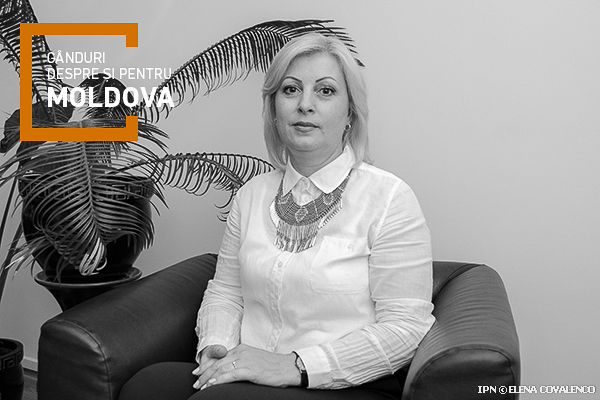
Society proved that Moldova is growing. IPN series

On the occasion of the 25th anniversary of the declaration of Moldova’s Independence, IPN News Agency decided to depict the portrait of the current Republic of Moldova. For the purpose, we challenged a number of people, including state officials, politicians, businessmen, civil rights activists and persons without posts and titles, but who have what to say. The generic picture is entitled “Thoughts about and for Moldova”.

Iulia Iabanji, director of the Organization for Small and Medium Enterprises Sector Development (ODIMM): “In 25 years of Independence, Moldova managed to assert its European direction and all the events that accompanied this aspiration – the Association Agreement, the liberalization of the visa regime – prove we can have faith in our future”.


Moldova has reached 25 years of Independence, in which time our society has shown that “we have traditions, values inherited from our ancestors, which we kept as sacred and we are proud to be known in the world thanks to them”, says Iulia Iabanji. She thinks that the action plan for modernizing the country is impressive. Today’s Moldova has a modern economy with market instruments, although it still has to catch up with other European countries. According to Iabanji, it is important that the action plan is implemented with the participation of the whole society, from kids to adults, “because the Europeanization process concerns us all, not only the authorities”.

Through its programs, ODIMM tries to change the mentality of company executives, to teach them to think creatively, strategically, long-term. “A successful business requires a strategic development plan for at least 3 years. The entrepreneur must know what commodity the company will produce, where it will sell it, who the potential buyer is, what the customer’s desires are and what benefits is he or she expecting from this activity. Besides production, the entrepreneur must be up to date with all the market trends, must look for new partners and new markets”, explained the ODIMM director.

In her opinion, entrepreneurship in Moldova is on the rise. The laws are being improved and adapted to the requirements of the business environment and European standards. The mentality of employers and employees is changing as well. Thanks to the liberalization of the visa regime, Moldovans can bring home the most modern technologies and equipment from the EU, exchange experience and good practices, analyze the efficient business development processes in EU countries. Two key elements of Moldovan business that need to change are the outdated technologies and equipment. Only by accomplishing this goal can Moldovan entrepreneurs access and enjoy success on the European market.


Iulia Iabanji thinks that Moldova will be flourishing when all the field of socio-economic development work as a unitary whole, complementing each other. Economic growth must be accompanied by the development of physical infrastructure: roads, gas pipes, sewage, water supply, electrical networks and all the auxiliary infrastructure. This includes the need for qualified personnel. The social infrastructure is important as well – schools, kindergartens, nursing homes, etc. All the concerned institutions must participate in this process: local and central public authorities, support organizations, in order to find solutions to create attractive conditions for developing a business and decent living conditions, so that young people can stay in their native town.

As regards the need for qualified specialists, the ODIMM director feels this is one the major problems in Moldova. Companies need qualified and experienced workers and experience comes only through practice. Unfortunately, the equipment used in the educational institutions is older and worse than the equipment used by businesses. Moldovan companies need good specialists and cannot afford to hire inexperienced youth. In this situation, young people choose to go abroad.


Iabanji herself says that despite having some good offers from abroad, she wouldn’t be able to leave Moldova for long, regardless of how financially rewarding the offer is. “We all know how difficult it is to launch a business here. Compared to European countries, there is less support from the state, but it’s still not impossible. So far, the PARE 1+1 Program helped returning Moldovan migrants launch over 750 enterprises and 90% of them are still up and running. This shows Moldova is on the right path and business opportunities here are improving”, said Iabanji.


The ODIMM director thinks the service sector in Moldova is insufficiently explored. Most rural settlements lack necessary services like repair shops for electronics, clothings and shoes, hairdressers, gyms, recreation pensions. All these services would mean new businesses in villages. One the priorities of the Ministry of Economy is the creation of value chains in the processes of production and sale of goods, so-called clusters. A cluster links the manufacturer with research, science, consultancy and promotion on other markets. Iulia Iabanji insists that Moldova must take inspiration from the experience of other countries, where all the aforementioned elements work together and achieve efficient results.

Comparing today’s entrepreneurial sector with that of 25 years ago, Iulia Iabanji thinks that the mentality, the business culture, the management style and application fields have changed. Back then, entrepreneurs were at the beginning, afraid of changes, uncertain of their own strength, without long-term development visions. Only the smart ones entered this sector and those who didn’t have any alternatives after the massive lay-offs at the time. The first cooperatives appeared, the first individual enterprises and small farms, all started chaotically, without any predictability. Now entrepreneurs are more responsible, competent, market and consumer-oriented. The socio-corporative responsibility of the private sector increased. We have many success stories that can serve as models for beginners. In order to facilitate the transfer of experience, ODIMM plans to launch some mentorship programs.

“I dream that in 10 years, we will have the rule of law established and all our rights, including in the business sector, will be protected, favoring those who respect the law and contractual obligations. When starting a business, a man should think only about how to produce a certain commodity and how to develop the company. In case it doesn’t work out, he should be able to quit without any fuss”, says Iabanji. Moldova can have a prosperous future, but in order to achieve it “we need to join our forces and start from having some national pride, respect towards the country, towards our close ones, towards this land”. “We have to be responsible in any decision we take, in any action we do, because the well-being of the whole people depends on each of us. What I know for sure is that Moldova is a young country, and all failures and mistakes, as well as successes, will help us flourish. We all want it and we must transform this desire in to concrete goals we can achieve. Very simple!”, concluded the ODIMM director.


Anastasia Rusu, IPN

The articles of the series “Thoughts about and for Moldova” started to be published on July 18. Among the protagonists are: Dumitru AlaibaIurie CiocanAna-Maria Ţulea, Ion Manole,Olga GagauzStella CiobanuIurie LeancăVictor ParlicovDoru CuroşuIgor MeriacreValeria ŞeicanCiprian RaeţchiAndrei NăstaseGhenadie GâlcăArcadie Barbăroşie,Valeriu Matei, Eugen DogaDumitru PostovanPetru MacoveiTatiana Negruş,Maia Sandu, Viorel SoltanValentin Guţan, Gheorghe ErizanuMariana Onceanu-Hadârcă,Viorel CibotaruVictor Micu, Sergiu ProdanIgor DodonAureliu Batrînac, Alexandru PleşcaDionis CenuşaKalman Mizsei, Petru Bodarev, Marian LupuPavel Filip, Andrian Candu.


The former head of the Parliament’s Legal Department, Ion Creanga, accused of treason, remains under judicial control for another 60 days. The information regarding the extension of the measure was confirmed for IPN by Emil Gaitur, the spokesperson for the Prosecutor’s Office for Combating Organized Crime and Special Cases.

Last week, Ion Creanga appeared before the magistrates after several months of absence. The court informed the defense that, according to the conclusions of the forensic medical examination, the accused is fit to participate in the trial. At the same time, it was ordered to examine the case file in general procedure, with the commencement of the judicial investigation.

In the same meeting, the prosecutor requested the extension of judicial control and the possibility of enforced appearance in case of non-attendance at court. The defense described the move as unfounded, arguing that the extension of the preventive measure is not based on concrete facts.

The next court session is scheduled for the month of September.

The former official is accused of treason and conspiracy against the state. According to prosecutors, during the period 2023-2024, he allegedly maintained correspondence and had clandestine meetings with an assistant to the military attaché of the Russian Federation Embassy in Chisinau. The former head of the Legal Department of the Parliament was detained in July 2024, when he allegedly received 500 dollars from a Russian official. Ion Creanga pleads not guilty.

0 FacebookTwitterPinterestEmail


Society proved that Moldova is growing. IPN series

On the occasion of the 25th anniversary of the declaration of Moldova’s Independence, IPN News Agency decided to depict the portrait of the current Republic of Moldova. For the purpose, we challenged a number of people, including state officials, politicians, businessmen, civil rights activists and persons without posts and titles, but who have what to say. The generic picture is entitled “Thoughts about and for Moldova”.

Iulia Iabanji, director of the Organization for Small and Medium Enterprises Sector Development (ODIMM): “In 25 years of Independence, Moldova managed to assert its European direction and all the events that accompanied this aspiration – the Association Agreement, the liberalization of the visa regime – prove we can have faith in our future”.


Moldova has reached 25 years of Independence, in which time our society has shown that “we have traditions, values inherited from our ancestors, which we kept as sacred and we are proud to be known in the world thanks to them”, says Iulia Iabanji. She thinks that the action plan for modernizing the country is impressive. Today’s Moldova has a modern economy with market instruments, although it still has to catch up with other European countries. According to Iabanji, it is important that the action plan is implemented with the participation of the whole society, from kids to adults, “because the Europeanization process concerns us all, not only the authorities”.

Through its programs, ODIMM tries to change the mentality of company executives, to teach them to think creatively, strategically, long-term. “A successful business requires a strategic development plan for at least 3 years. The entrepreneur must know what commodity the company will produce, where it will sell it, who the potential buyer is, what the customer’s desires are and what benefits is he or she expecting from this activity. Besides production, the entrepreneur must be up to date with all the market trends, must look for new partners and new markets”, explained the ODIMM director.

In her opinion, entrepreneurship in Moldova is on the rise. The laws are being improved and adapted to the requirements of the business environment and European standards. The mentality of employers and employees is changing as well. Thanks to the liberalization of the visa regime, Moldovans can bring home the most modern technologies and equipment from the EU, exchange experience and good practices, analyze the efficient business development processes in EU countries. Two key elements of Moldovan business that need to change are the outdated technologies and equipment. Only by accomplishing this goal can Moldovan entrepreneurs access and enjoy success on the European market.


Iulia Iabanji thinks that Moldova will be flourishing when all the field of socio-economic development work as a unitary whole, complementing each other. Economic growth must be accompanied by the development of physical infrastructure: roads, gas pipes, sewage, water supply, electrical networks and all the auxiliary infrastructure. This includes the need for qualified personnel. The social infrastructure is important as well – schools, kindergartens, nursing homes, etc. All the concerned institutions must participate in this process: local and central public authorities, support organizations, in order to find solutions to create attractive conditions for developing a business and decent living conditions, so that young people can stay in their native town.

As regards the need for qualified specialists, the ODIMM director feels this is one the major problems in Moldova. Companies need qualified and experienced workers and experience comes only through practice. Unfortunately, the equipment used in the educational institutions is older and worse than the equipment used by businesses. Moldovan companies need good specialists and cannot afford to hire inexperienced youth. In this situation, young people choose to go abroad.


Iabanji herself says that despite having some good offers from abroad, she wouldn’t be able to leave Moldova for long, regardless of how financially rewarding the offer is. “We all know how difficult it is to launch a business here. Compared to European countries, there is less support from the state, but it’s still not impossible. So far, the PARE 1+1 Program helped returning Moldovan migrants launch over 750 enterprises and 90% of them are still up and running. This shows Moldova is on the right path and business opportunities here are improving”, said Iabanji.


The ODIMM director thinks the service sector in Moldova is insufficiently explored. Most rural settlements lack necessary services like repair shops for electronics, clothings and shoes, hairdressers, gyms, recreation pensions. All these services would mean new businesses in villages. One the priorities of the Ministry of Economy is the creation of value chains in the processes of production and sale of goods, so-called clusters. A cluster links the manufacturer with research, science, consultancy and promotion on other markets. Iulia Iabanji insists that Moldova must take inspiration from the experience of other countries, where all the aforementioned elements work together and achieve efficient results.

Comparing today’s entrepreneurial sector with that of 25 years ago, Iulia Iabanji thinks that the mentality, the business culture, the management style and application fields have changed. Back then, entrepreneurs were at the beginning, afraid of changes, uncertain of their own strength, without long-term development visions. Only the smart ones entered this sector and those who didn’t have any alternatives after the massive lay-offs at the time. The first cooperatives appeared, the first individual enterprises and small farms, all started chaotically, without any predictability. Now entrepreneurs are more responsible, competent, market and consumer-oriented. The socio-corporative responsibility of the private sector increased. We have many success stories that can serve as models for beginners. In order to facilitate the transfer of experience, ODIMM plans to launch some mentorship programs.

“I dream that in 10 years, we will have the rule of law established and all our rights, including in the business sector, will be protected, favoring those who respect the law and contractual obligations. When starting a business, a man should think only about how to produce a certain commodity and how to develop the company. In case it doesn’t work out, he should be able to quit without any fuss”, says Iabanji. Moldova can have a prosperous future, but in order to achieve it “we need to join our forces and start from having some national pride, respect towards the country, towards our close ones, towards this land”. “We have to be responsible in any decision we take, in any action we do, because the well-being of the whole people depends on each of us. What I know for sure is that Moldova is a young country, and all failures and mistakes, as well as successes, will help us flourish. We all want it and we must transform this desire in to concrete goals we can achieve. Very simple!”, concluded the ODIMM director.


Anastasia Rusu, IPN

The articles of the series “Thoughts about and for Moldova” started to be published on July 18. Among the protagonists are: Dumitru AlaibaIurie CiocanAna-Maria Ţulea, Ion Manole,Olga GagauzStella CiobanuIurie LeancăVictor ParlicovDoru CuroşuIgor MeriacreValeria ŞeicanCiprian RaeţchiAndrei NăstaseGhenadie GâlcăArcadie Barbăroşie,Valeriu Matei, Eugen DogaDumitru PostovanPetru MacoveiTatiana Negruş,Maia Sandu, Viorel SoltanValentin Guţan, Gheorghe ErizanuMariana Onceanu-Hadârcă,Viorel CibotaruVictor Micu, Sergiu ProdanIgor DodonAureliu Batrînac, Alexandru PleşcaDionis CenuşaKalman Mizsei, Petru Bodarev, Marian LupuPavel Filip, Andrian Candu.


Environmental inspectors in Floresti have detected dozens of cases of illegal water use for irrigation, as part of control actions carried out in June. As a result of the checks, fines of over 52 thousand lei were imposed, reports IPN.

According to the Environmental Protection Inspectorate, the checks were aimed at verifying whether individuals and legal entities comply with environmental legislation and use surface water resources legally. Following the checks, environmental inspectors drew up 43 minutes of contravention. Also, the condition of the aquatic basins and the related hydro-technical constructions was checked.

The Environmental Protection Inspectorate warns that water resources should only be used in compliance with environmental legislation and based on the permits provided by law. The inspectors mention that checks will continue in the following period, to prevent violations and protect the quality and quantity of water resources.

This journalistic material was developed by the IPN Press Agency, within the framework of the Small Grants Program for Mass Media “Community Journalism for a Healthy Environment and Green Justice”, carried out within the project “A Green Justice for a Protected Environment and Sustainable Communities in the Republic of Moldova”, implemented by AO EcoContact, with the support of Sweden. The content of this journalistic material is the sole responsibility of the authors and does not necessarily reflect the opinions of EcoContact or the donor.

0 FacebookTwitterPinterestEmail


1 IANUARIE, 2025
1 IANUARIE, 2025